
Somos arrastrados por nuestros deseos sensuales a la perdición como las polillas hacia el fuego.
 Bosque Theravada
MN 39 {9M.4.9} Mahaassapura Sutta – Gran discurso en Assapura
El Buda aclara el significado de “las cosas que hacen a uno recluso” mediante un discurso que cubre los diferentes aspectos de la práctica monástica.
Acerca de bodhisatta – About bodhisatta
Pregunta de Julio:
Dentro de la zona de coherencias que puede establecerse entre el Canon Pali, el tripitaka chino y el tibetano, ¿existe la noción de boddhisattva- esto es, un ser que renuncia al nibbana para trabajar por la iluminación de todos los seres?
Bueno, ¡esta es una buena! La respuesta depende de qué entendamos por “coherencia”. Si tomamos un enfoque crítico de los textos basado en datos históricos, entonces les quitamos los añadidos posteriores y nos fijamos en los sutras antiguos de los Agamas, que más o menos son compartidos por todas las tradiciones. Así, la respuesta es directa. No hay noción de Bodhisatta en el sentido que mencionas. La palabra bodhisatta se reserva, en los estratos más antiguos, a Siddhatta Gotama después de que dejase el hogar y estuviese activamente “esforzándose para el despertar”, que es posiblemente lo que originalmente significaba la palabra. En sus vidas pasadas, no se le llama Bodhisatta, y no hay sugerencias de que en sus vidas pasadas estuviese desarrollando una práctica espiritual que llevase al despertar. Al contrario, los suttas afirman que las prácticas que realizó en sus vidas pasadas “no llevaban al despertar”. Además, él afirma que, como todos los demás, alcanzó el Despertar practicando el óctuple sendero. Los textos antiguos siempre describen a Siddhattha habiendo abandonado el hogar y buscando la respuesta a la pregunta “¿Qué es lo bueno?” (kimkusalagavesi). No sabía lo que estaba hacienda, y los textos antiguos dan la vívida impression de un hombre decidido a encontrar su camino. Además, no hay mención alguna de que estuviese practicando por el beneficio de los seres sintientes. Los textos antiguos hablan de su búsqueda de la Verdad, y solo después le llega el pensamiento de compartir sus revelaciones con otros. Hay sugerencias esporádicas en los Nikayas/Agamas de la doctrina del Bodhisatta desarrollada, como en el relato del nacimiento de Siddhatta, peor estos son excepcionales, y son claramente creaciones posteriores. Por otra parte, si tomamos “coherencia” en el sentido de lo que se comparte más o menos entre las escuelas, entonces sí, la idea del Bodhisatta está ampliamente compartida. Por supuesto que las escuelas Mahayana desarrollan más la idea, pero la noción básica también se encuentra en el Theravada. Empieza a aparecer en los textos de la porción posterior del Canon Pali, quizás 300 o 400 años después del Buda. Así que la posición de cada uno en esto reflejará sus fuentes de conocimiento. Si tomamos las tradiciones como primarias, y damos crédito a la autoridad spiritual y sabiduría de incontables generaciones de maestros, entonces aceptaríamos la docrtina del Bodhisatta. Después de todo, es perfectamente possible que tales maestros hayan tenido acceso a comprensiones que escapen a nuestro conocimiento. Por otra parte, si tomamos un enfoque más empírico, veríamos la doctrina del bodhisatta como un desarrollo histórico que responde a cuertas necesidades entre las comunidades budistas, especialmente llenando el vacío emocional dejado por la ausencia del Buda, tan desgarradoramente sentido en el arte budista más temprano.
________________________________________________________________
Julio’s question:
Within the area of coherence that can be established among the Pali Canon, the Chinese Tripitaka and thetTibetan one, does the notion of a boddhisattva – that is, a being that renounces Nibbana in order to work for the Illumination of all beings- exist?
Well, this is a controversial one! The answer depends on how we approach the notion of ‘coherence’. If we take a historically-based text critical approach, then we strip back the later additions and focus on the early Agama sutras, which are more or less held in common by all traditions. There, the answer is straightforward. There is no notion of a Bodhisatta in the sense you mention. The word bodhisatta is reserved, in the earliest strata, for Siddhattha Gotama after he has left home and is actively ‘striving for awakening’, which is what the word Bodhisatta probably originally meant. In his past lives he is not called a Bodhisatta, and there is no suggestion that in his past lives he was developing a spiritual practice that would lead to awakening. On the contrary, the Suttas state that the practices he did in past lives ‘did not lead to awakening’. He further states that he, like anyone else, reached Awakening by practicing the eightfold path. The early texts always depict Siddhattha having left home, seeking an answer to the question ‘what is the good?’ (kimkusalagavesi). He did not know what he was doing, and the early texts give a vivid impression of a man intent on finding his way. There is, in addition, no mention at all that he was practicing for the sake of sentient beings. Early texts speak of his search for the Truth, and only afterwards does the thought of sharing his revelations with others come to him. There are occasional suggestions in the Nikaya/Agama texts of the developed Bodhisatta doctrine, such as in the account of Siddhattha’s birth, but these are exceptional, and are clearly later developments.
On the other hand, if we take ‘coherence’ in the sense of what is more or less held in common among the schools, then yes, the idea of the Bodhisatta is largely shared. Of course the Mahayana schools develop the idea further, but the basic notion is found equally in the Theravada. It starts to appear in the texts of the later portion of the Pali canon, perhaps 300-400 years after the Buddha. So one’s own position on this will reflect one’s sources of knowledge. If we take the traditions as primary, and give credence to the spiritual authority and wisdom of countless generations of teachers, then we would accept the Bodhisatta doctrine. It is, after all, perfectly possible that such Masters would have access to understandings that escape our ken. On the other hand, if we take a more empirical approach, we would see the bodhisatta doctrine as a historical development that responded to certain needs among the Buddhist communities, especially filling the emotional gap left by the absence of the Buddha, so heartbreakingly felt in the earliest Buddhist art.
Metta bhavana
Pregunta de Hugo:
Estimado Ajahn, Últimamente estoy empezando a trabajar metta bhavana y me gustaría saber cúal es su forma de practicarla. También me gustaría saber si esta práctica está relacionada con perdonarse a uno mísmo cuando sabemos que hemos hecho algo mal y si para esto hay alguna variación especial del método. Mis mejores deseos, Hugo
Querido Hugo,
Para empezar, hasta querer hacer meditación metta es ya una gran cosa: significa que has llevado al corazón la noción de que deberíamos ‘querer a nuestros enemigos’ y que estás intentando averiguar realmente cómo hacerlo. Es aquí donde el acercamiento Budista realmente brilla. Metta bhavana es una de las verdaderas grandes prácticas que ofrece el Budismo. Normalmente, sin embargo, encuentro que frecuentemente se enseña ya sea en libros o en formas más a la ligera que realmente no llegan al corazón del asunto. Fui muy afortunado de encontrar, cuando todavía era un novicio, una forma de hacer meditación metta que me venía muy bien, y que creo que es el método más profundo y sistemático que hay por ahí. Fue enseñada por Phra Ajan Maha Chatchai, un monje de Bangkok poco conocido. Me enseñó como practicar metta, respondiendo pacientemente a todas mis tontas preguntas. Poner sus enseñanzas en un libro ha sido una idea desde hace mucho tiempo, pero permanece en mi lista (extensa) de cosas por hacer. Mientras tanto, puedes encontrar algunas de mis charlas sobre meditación metta aquí: http://www.dhammanet.org/download.php?list.17
En términos de perdón, sí, es una parte vital de metta. Phra Ajan Chatchai enfatizaba la importancia crítica de metta para con uno mismo, y esto es imposible si uno es incapaz de perdonar. Esto es un asunto importante, y no puedo tratarlo sin más detalles, aunque haré solo una apreciación. La meditación no puede resolverlo todo. Si ha surgido un verdadero problema, especialmente aquellos donde uno ha causado daño o dolor a otro, entonces esto debe ser tratado reparando el daño y pidiendo perdón a esa persona. Si algo sigue surgiendo en la meditación y uno no puede librarse de ello, es una buena señal de que algo más es necesario. _________________________________________________________________
Hugo’s question:
Dear Ajahn,
Recently I’m beginning to work with metta bhavana and I would like to know how is your way of practice.
Also I would like to know if this practice is related with «forgive oneself» when we know we have done something wrong. ¿Is there a special way of practice within metta bhavana to do this?
Best wishes,
Hugo
Dear Hugo, First up, even wanting to do metta meditation is such a great thing: it means you’ve taken to heart the notion that we should ‘love our enemies’ and you’re trying to figure out how to actually do it. It’s here that the Buddhist approach really shines. Metta bhavana is one of the truly great practices that Buddhism has to offer. Typically, however, I find that it is usually taught in either textbook or wishy-washy ways that don’t really get to the heart of the thing. I was so lucky to find, when I was still a novice, a way of doing metta meditation that really suits me, and which I believe is the most profound and systematic method around. This was taught by Phra Ajahn Maha Chatchai, a little known Bangkok monk. He taught me how to do metta, patiently answering all my very silly questions. It has been a long term idea to put his teachings into a book, but this remains on my (extensive) to-do list. Meanwhile, you can find some of my talks on metta meditation here: http://www.dhammanet.org/download.php?list.17 In terms of forgiveness, yes this is a vital part of metta. Phra Ajahn Chatchai emphasizes the critical importance of metta for oneself, and this is impossible if one is unable to forgive. This is a big topic, and I can’t really address it without more details, but i would make just one point. Meditation can’t solve everything. If there is a genuine problem that has arisen, especially one where one has caused harm or pain to another, then that must be addressed through redressing the harm and asking forgiveness from that person. If something keeps arising in meditation and one cannot escape it, this is a good sign that something else is needed.
¿Qué es el Nibbana? – What is Nibbana?
Pregunta deJulio:
Querido Ajahn Por intermedio de los amigos-as de Bosque Theravada deseaba preguntarle sobre los siguientes tópicos. – ¿Qué es nibbana?
Querido Julio,
Gracias por tus preguntas.
– Nibbana:
Para mí, la distinción más práctica a hacer es que cuando el Buda habla sobre el Nibbana ontológicamente, lo hace de forma negativa, pero cuando habla psicológicamente, lo hace de forma positiva. Siempre que se refiere a la existencia del Nibbana usa términos negativos (‘he aquí lo no-nacido, lo no-hecho, lo no-creado…). Cuando habla de nuestra respuesta emocional al Nibbana, lo hace siempre de manera altamente positiva (beatitud última, la isla, el refugio, lo pacífico, lo sublime…). Mantener el equilibro entre estos dos enfoques nos ayuda a evitar posiciones extremas.
Una vez que comenzamos a decir que el Nibbana es algo, empezamos a endurecer nuestras posiciones doctrinales que nos distraen de la experiencia real. Yo siendo que deberíamos respetar más la simplicidad del Buda en esta materia y no dejarnos atrapar por la teología. Existen varias teorías elaboradas a lo largo de la historia del budismo que intentan definir al Nibbana en términos más ontológicamente positivos, pero yo no las encuentro convincentes ni atractivos. Vale la pena notar que, aunque hoy en día es común pensar en el Nibbana en términos de la Conciencia Universal o algo por el estilo, semejantes ideas no encuentran huellas a lo largo del primer milenio después del Buda. Si ésto fuera lo que el Buda realmente enseñaba, me pregunto por qué la gente se tomó tanto tiempo en descubrirlo…
Hay un nuevo artículo sobre el Nibbana en el último número de Buddhist Studies Review escrito por mi buen amigo, el Ven. Brahmali, titulado “What the Nikayas Say and Do not Say about Nibbana (Qué dicen y qué no dicen los Nikayas acerca del Nibbana – http://www.equinoxjournals.com…/view/7139). Confieso que aún lo lo he leído realmente (sí, esto está en mi listado de cosas por hacer) pero cualquier cosa escrita por el Ven. Brahmali ha de ser bien considerada como digna de ser leída. Desde luego, allí está el escandaloso precio de 12 libras para descargar un archivo en pdf!, lo cual explica el por qué no tengo prisa en publicar algo en BSR en el futuro.
_______________________________________________________________
Julio’s question:
Dear Ajahn Through the friends at Bosque Theravada I’d like to ask you about the following topics: -What is Nibbana?
Dear Julio, Thanks for the questions. – Nibbana: For me, the most useful distinction to make is that when the Buddha speaks of Nibbana it is ontologically negative but psychologically positive. Whenever he addresses the existince of Nibbana, it always uses negative terms (‘There is the unborn, the unmade, the uncreated…). When he speaks of our emotional response to Nibbana it is always highly positive (ultimate bliss, the island, the refuge, the peaceful, the sublime…) Balancing these two approaches helps us to avoid extreme positions. Once we start to say that Nibbana is anything, we start to pin ourselves down in doctrinal positions that distract from the actual experience. My feeling is that we should respect the Buddha’s simplicity in this matter and not get too caught up in the theology. There are various theories in Buddhist history that attempt to define Nibbana in more ontologically positive terms, but I don’t find these either persuasive or appealling. It is worth noting that, although today it is common to think of Nibbana as a Universal Consciousness or somesuch, such ideas did not get any traction in Buddhism for nearly a thousand years after the Buddha. If this is what the Buddha was really teaching, i wonder why it took so long for anyone to notice… There’s a new article on Nibbana in the latest Buddhist Studies Review by my good friend Ven. Brahmali, called What the Nik?yas Say and Do not Say about Nibb?na (http://www.equinoxjournals.com…/view/7139). I confess I haven’t actually read it myself yet (yes, it’s on my to-do list) but anything by Ven Brahmali will be well considered and worth reading. Of course, there is the outrageous price of twelve pounds for downloading a pdf file (!), which is why I’m in no hurry to publish anything with the BSR in future.
Kayagatasati
Preguntas de Federico:
Quiero agradecer a BT la traducción que hizo de mi anterior pregunta y su respectiva respuesta. Mi nueva consulta a Bhante Sujato es: En el Mahamogallana Sutta (Udana 3:5) se afirma que el Bendito, viendo al venerable Mogallana sentado en absorta meditación, practicando la atención consciente sobre el propio cuerpo (kayagataya satiya), exclamó: Con la atención consciente inmersa en el cuerpo (sati kayagata), bien establecida, restringiendo la séxtuple base de los sentidos, siempre concentrado, el monje puede alcanzar el nibbana por sí mismo. De lo anterior pareciera inferirse que con la sola práctica de kayagatasati es posible alcanzar el nibbana. Preguntas:
1.En este particular caso, ¿qué debería entenderse por kayagatasati durante la meditación sentada?
2.¿Es kayagatasati lo mismo que kayanupassana satipatthana? Si no significan lo mismo, ¿en qué estriba la diferencia entre ambas?
3.En la tradición que usted representa, ¿se acepta que el nibbana pueda ser logrado por la sola práctica de kayagatasati, según afirma este sutta?
Agradeceré su ilustración al respecto.
Hola Federico,
1.
Básicamente, desde luego, kayagatasati significa simplemente estar atento de nuestro cuerpo. Pero también, como lo indicas correctamente, se lo usa de una manera tal que trasciende los límites de de esta definición. Ésta es una cualidad del Dhamma: si nosotros investigamos cada camino con suficiente profundidad, esto se extenderá para iluminar a todos los demás caminos también.
El texto principal, desde luego, es el Kayagatasati Sutta que empieza con la atención consciente básica puesta en el cuerpo, pero procede a través de los jhanas y poderes psíquicos, hasta culminar en el Nibbana.
Existe una considerable confusión acerca de estas nociones, en su mayoría procedentes de la interpretación demasiado literal de la palabra “cuerpo”. Tenemos que ser claros desde principio: el cuerpo (kaya) no necesariamente significa el cuerpo físico común y corriente (olarika kaya, en pali). Este término se usa como modismo en diferentes sentidos. Por ejemplo, el “cuerpo-hecho-por-la-mente” (manomayakaya), que corresponde al “cuerpo sutil” o a la “energía corporal” tal como se lo suele denominar en modernos círculos espirituales. Se dice que los logros inmateriales (arupa) han de ser “tocados con el cuerpo” y hasta el Nibbana ha de ser realizada “con el cuerpo”. En este sentido, “kaya” obviamente no tiene nada que ver con el cuerpo físico, sino que es un modismo que enfatiza la inmediatez de una experiencia directa y personal.
Todo esto suena muy abstracto, sin embargo se corresponde maravillosamente con la experiencia de la meditación sentada. Cuando empezamos, focalizamos nuestra atención sobre la experiencia interna de algún fenómeno físico, como por ejemplo, la respiración. En este momento, esto es kayagatasaki. La respiración cambia, se vuelve más sutil; uno empieza a observar la tonalidad de la sensación de la respiración, su luz y su resplandor. Estos son ya aspectos mentales pero los mismos aparecen a partir de las sensaciones físicas y no como entidades separadas. Es así -creo yo- cómo podría decirse que todo el camino de la práctica budista está incluido dentro de kayagatasati.
2. En el sentido básico es lo mismo. Sin embargo, kayagatasati es tratado, como hemos visto, como un el camino entero, en cuyo sentido abarca a todos los diferentes aspectos, incluidos los cuatro satipatthanas. Por otro lado, kayanupasana satipatthana, se trata como una práctica puramente preliminar basada directamente en el cuerpo físico.
3.
Sí, si es que kayagatasati se comprende en el sentido amplio. Dentro de la Tradición Tailandesa del Bosque, ésta es la práctica más importante de todas. Ajahn Brahm también enfatiza kayagatasati, especialmente a través de la atención consciente en la respiración.
_______________________________________________________________
Federico’s questions:
Dear Ajahn In the Mahamogallana Sutta (Udana 3:5) it is claimed that the Blessed One, on seeing venerable Mogallana sitting in absorbed meditation, practicing mindfulness of his own body (kayagataya satiya), exclaimed: “With mindfulness immersed in the body well established, restrained with regard to the six media of contact — always centered, the monk can know Unbinding for himself.” (translation: Thanissaro) From that it could be inferred that with the sole practice of kayagata sati is possible to attain Nibbana. Questions:
1.In this particular case, what should be understood for kayagatasati during sitting meditation?
2.Is kayagatasati the same as kayanupassana satipatthana? If they aren’t, what is the difference between them?
3.In your tradition, is it accepted that Nibbana be achieved through the sole practice of kayagatasati, as it is stated in this sutta?
Thank you Federico
Hi Fredrico,
1.
In a basic sense, of course, kayagatasati simply means being mindful of our body. But as you so rightly observe, it is used in ways that clearly transcend such limited definitions. This is one quality of the Dhamma: if we investigate any avenue deeply enough, it will open out to illuminate all other avenues. The primary text is, of course, the Kayagatasati Sutta, which starts with the basic mindfulness of the body, but proceeds through jhanas and psychic powers and culminates in Nibbana. There is considerable confusion about this notion, mostly stemming from overly literal interpretations of the word ‘body’. We should be clear from the start: body (kaya) does not just mean the ordinary physical body (olarika kaya in Pali). It is used in diverse idiomatic senses, for example the ‘mind-made body’ (manomayakaya), which corresponds to the ‘subtle body’ or ‘energy body’ that is spoken about in modern spiritual circles. The formless (arupa) attainments are said to be ‘touched with the body’, and even Nibbana is said to be realized ‘by the body’. In these senses kaya obviously has nothing to do with the physical body, but is an idiom that emphasizes the immediacy of direct personal experience. This all sounds very abstract, but in fact it corresponds very beautifully with the experience of sitting meditation. When we first start, we focus attention on the inner experience of some physical phenomonen, such as the breath. At that time, that is kayagatasati. The breath changes, becomes more subtle. One starts to see the feeling-tone of the breath, the light and radiance of it; these are mental aspects, but they appear from inside the physical sensation, not as separate entities. This is, I believe, how the entire path of Buddhist practice can be said to be included within kayagatasati.
2.
In the basic sense these are the same. However, kayagatasati is treated, as we have seen, as an entire path, and so encompasses all the different aspects, including all four satipatthanas. Kayanupassana satipatthana, on the other hand, is treated as purely the preliminary practices that are based directly on the physical body.
3.
Yes, if kayagatasati is understood in the broad sense. In the Thai forest tradition, this is the most important practice of all. Ajahn Brahm also emphasizes kayagatasati, particularly through mindfulness of breathing.
¿Quién presidió el «Segundo Concilio Budista»? – Who chaired the «Second Bhuddhist Council»?
Pregunta de Isidatta
Tengo una pregunta acerca de Sattasatikakkhandhaka, más específicamente, ¿por qué se dice que el “Segundo Concilio Budista” fue presidido por el Ven. Yassa, mientras que podemos leer ahí que fue el Ven. Revata quien convocó la asamblea y la estaba dirigiendo?
Oh, es una pregunta compleja. De hecho existe una diversidad considerable en distintos Vinayas sobre quién hizo que el Concilio se llevara a cabo. En Lamotte, si la memoria no me falla, existe una tabla con diferentes nombres. Ésto probablemente no significa nada más sino que el Concilio, de hecho fue convocado por un grupo, más bien que por un individuo, en conformidad con el Vinaya, y que las fuenetes -creo yo- son más cercanas a la historia que la idealizada narrativa del Primer Concilio, con el repertorio de sus estandarizadas figuras.
__________________________________________________________________
Isidatta’s question
I have a question about the Sattasatikakkhandhaka, more specifically, why it is said that there was a Ven. Yassa that chaired the “Second Council” while we can read that was a Ven. Revata who convened the assembly and headed it up?
O, a complex question. There is in fact considerable diversity in who the Council was said to be run by in the different Vinayas. There is, if my memory serves me well, a table in Lamotte with the different names. This probably means nothing more than that the Council was in fact run by a group rather than an individual, in conformity with the Vinaya, and that the sources, i believe, remain closer to the history than the more idealized narrative of the First Council, with its standardized, stock figures.
SN 12,15 Kaccanagotta Sutta – Discurso con Kaccanagotta
El Buda explica al venerable Kaccanagotta cómo el origen dependiende se aplica al desarrollo de la recta visión (samma ditthi).
Una experiencia virtual
Ya llevo dos semanas participando activamente en Second Life, en las actividades programadas por un monje theravada amigo mío a través del centro budista que agrupa también a otras escuelas.
Cuando Bhante lo comentó hace un mes realmente no entendía qué hacía un monje con un personaje virtual… y como me cuesta no decir lo que pienso, pues se lo pregunté y sencillamente contestó «¿Y por qué no?»… y lo pensé durante la siguiente media hora sin concluir claramente al respecto. Pero cuando vi las fotos que tomó al lugar de conferencia me alenté a entrar, después de todo si no me gustaba sólo había que borrar el usuario.
Dos semanas después ya estaba dentro, conociendo mi nuevo «juguete»… y sus múltiples usos. Cuando por fin pude conocer el Centro Budista, me maravillé, no sólo por lo hábil que puede ser el ser humano para recrear espacios sino también por lo bien que se veía todo. Finalmente conocí el lugar de conferencias y el resto del centro budista (incluida la biblioteca ^^), la vivienda que le fue regalada a mi amigo (igualita a los kutis de Australia), y otros regalitos como hábitos y cama, porque allí entendieron que él no tiene dinero y no puede tener dinero por lo que han procurado brindarle todo aquello que él necesite para realizar su labor. La visita guiada cerró con una invitación a 20 minutos de zazen en una sala de meditación, a la que asistimos Bhante y yo.
Entrando en materia, mi primera vez formalmente fue con una invitación a la recitación de los cánticos nocturnos… y si que estaba nerviosa. Cuando vi el lugar, algo dentro de mí se sentía allá y una vez comenzó la recitación mentalmente desdibujé ese «allá» virtual del «acá» en mi habitación. Seis personas más aceptaron a la invitación que cerró con una conversación sobre el MN 2 (después de leerlo, claro está). He de confesarles que mi corazón rebosaba de alegría por estar-y-no-estar allí, por la oportunidad de escuchar el Dhamma «en vivo y en directo». Por fin entendí aquel «¿y por qué no?».
Posiblemente para muchos, así como para mí lo fue en su momento, es un poco extraño oir de un monje que tiene vida virtual que también dedica al Dhamma. Cuando le dije a unos de mis amigos, me respondió «¿QUÉ?!! Pero es que si los monjes se tienen que dedicar a meditar y a enseñar, no a masificarse por internet porque eso no es una necesidad.. Es que hay monjes que no saben respetar el hábito amarillo». Bhante Yutth, como le decimos en SL, no le falta el respeto al hábito amarillo, ni ha olvidado cuáles son sus deberes como monje budista, creo que ahora tiene uno más… que realiza con amor y dedicación como si se tratara de conversación en la vida real.
Ya veremos qué pasa cuando vuelva a Tailandia a residir en el bosque…

El poder curativo de los preceptos
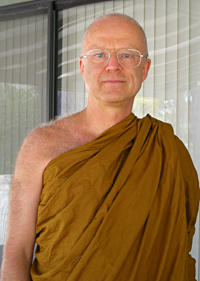
Hoy en día, mucha gente se acerca a las enseñanzas del Buda solamente con el fin de encontrar un equilibro emocional o espiritual. En este breve ensayo, Thanissaro Bhikkhu nos recuerda que una de las herramientas más efectivas para sanar a un corazón herido, se puede encontrar, cuando se cultiva el sila o la conducta virtuosa.